
Cooking Equipment
Exterior and accessible surface cleaning for ranges, ovens, fryers, griddles, charbroilers, and similar appliances, subject to shutdown and cool-down requirements.
Serving Gilbert, Arizona & surrounding areas

Restaurant equipment cleaning · Chandler, Arizona
Detailed cleaning for commercial cooking equipment, prep areas, and hard-to-reach surfaces, scheduled around your kitchen's operating hours.
Built around your operation
Restaurant Equipment Cleaning Chandler service addresses the grease, carbon, food residue, and dust that routine closing duties may leave behind. Gilbert Restaurant Cleaning cleans accessible equipment exteriors, removable components, undersides, casters, surrounding walls, and the floor areas exposed when movable units are pulled out. The written scope can cover a focused equipment list or coordinate equipment work with broader Restaurant Cleaning Chandler needs.
Every kitchen has different operating hours, equipment, and access limits. We review those details before work begins, identify surfaces that need special handling, and agree on which appliances can be moved or opened. Our team at a restaurant company Gilbert homeowners rely on brings the same careful scoping and respect for the property to commercial work in Chandler. The goal is a practical cleaning plan that supports your operation without making promises that conflict with equipment warranties, fire-system requirements, or food-safety procedures.
Defined equipment scope
A service plan may include ranges, ovens, fryers, griddles, charbroilers, salamanders, steam tables, reach-in units, prep tables, shelving, and other approved commercial equipment. Work is based on the appliance manufacturer's care instructions and the condition of each surface. Stainless steel, painted metal, aluminum, chrome, glass, rubber seals, and plastic controls do not all tolerate the same chemistry or abrasion.
Cleaning commonly begins with dry soil and loose debris removal. Greasy surfaces may then receive a compatible degreaser and controlled dwell time before agitation and extraction. Crevice brushes, non-scratch pads, microfiber cloths, and wet vacuums help reach hinges, legs, wheels, drip channels, and the exposed floor beneath movable units. Food-contact surfaces require an appropriate rinse and must be treated according to the product label and the restaurant's sanitation procedure.
This work does not replace licensed repair, internal electrical cleaning, gas-line service, hood suppression work, or certified exhaust-system cleaning. Those boundaries are documented before the job so the kitchen manager knows exactly what is included.

Detailed capabilities
Exterior and accessible surface cleaning for ranges, ovens, fryers, griddles, charbroilers, and similar appliances, subject to shutdown and cool-down requirements.
Exterior panels, handles, hinges, gaskets, accessible shelves, and approved interior surfaces on reach-ins and prep refrigeration units.
Prep tables, steam tables, hot holding units, racks, shelving, and adjacent splash areas can be added to the written scope.
Where equipment can be moved safely, crews address exposed floors, wall surfaces, legs, casters, utility-clearance areas, and accumulated debris.
Knobs, handles, control surrounds, door edges, hinges, and other frequently handled surfaces receive detailed attention with material-compatible products.
Work can be planned after shutdown, during a closure window, or in phases so cleaned equipment has time to dry before kitchen staff return.
A defined process
Step 1 of 5
We identify the equipment, surface materials, grease conditions, access restrictions, utilities, floor drains, and operating window. The manager can also flag manufacturer instructions or equipment that staff do not want moved.
Step 2 of 5
The plan lists included appliances and surfaces, exclusions, required cool-down time, and who is responsible for disconnecting or moving restricted equipment. This keeps cleaning work separate from repair and licensed trade work.
Step 3 of 5
Food, utensils, smallwares, and exposed ingredients must be removed or protected. Sensitive controls and nearby surfaces are covered as needed, and the crew confirms that included cooking equipment is off and cool.
Step 4 of 5
Technicians remove loose residue, apply compatible cleaning products, allow proper dwell time, agitate buildup, and recover the resulting soil. Removable components are cleaned only when their design and condition allow it.
Step 5 of 5
The crew checks the agreed work areas, wipes remaining residue, returns approved movable items to position, and reports damaged seals, loose parts, leaks, or other visible conditions that may need attention from restaurant management.
Local scheduling fit
Chandler kitchens range from compact restaurant suites near Downtown Chandler to larger operations around Chandler Fashion Center and the Price Road employment corridor. A small line with limited aisle clearance needs a different approach than a high-volume kitchen with several fryers, long cook lines, and large cold-side equipment. Access, loading arrangements, security procedures, and closure windows all affect crew planning.
Arizona heat also matters when equipment is cleaned near exterior doors, loading areas, or patio-service stations. Products can dry faster on warm surfaces, so technicians must control dwell time rather than allowing degreaser to dry in place. Cooking equipment must still cool before treatment, even when the available overnight window is short.
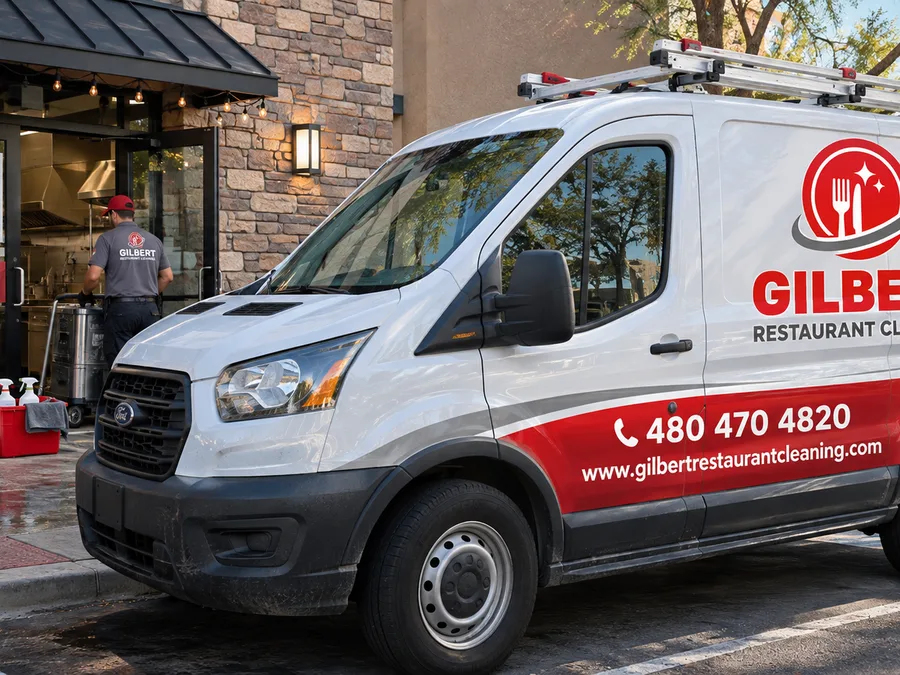
Gilbert Restaurant Cleaning operates from W. Commerce Ave. in Gilbert and plans Chandler work around the restaurant's real schedule. Managers receive a defined scope instead of a vague promise to deep clean everything. That clarity helps staff complete shutdown preparation, remove food and smallwares, and know which equipment will be ready for inspection when service is complete.
Cleaner equipment, clearer inspections
Grease and food residue build up where normal line cleaning is difficult: under fryers, around casters, beside hot equipment, inside door channels, and along wall-floor transitions. Detailed cleaning removes accessible deposits before they become harder to address. It can also make visual inspections easier by exposing worn gaskets, corrosion, loose hardware, or residue around a suspected leak.
Professional cleaning should support, rather than replace, the restaurant's established food-safety program. The Maricopa County Environmental Services Department regulates food establishments in Chandler, while restaurant management remains responsible for its operating procedures and inspection readiness. Cleaning products must be used according to their labels, and food-contact surfaces may require rinsing and sanitizing before use. Clean equipment must also be fully dry and correctly reassembled before the kitchen restarts it.
Exhaust hoods and ducts require their own specialized scope under applicable fire-safety practices. Equipment cleaning can address approved exterior surfaces and accessible areas near the cook line, but it should never be represented as a substitute for qualified hood and duct cleaning or fire-suppression service.
Share your equipment list, operating window, and problem areas to receive a clearly defined cleaning scope for your Chandler kitchen.
Call for a Free QuoteCommon questions
Pricing is based on labor, equipment type, buildup, access, and the number of items included. A lightly soiled prep area takes less time than a cook line with carbonized residue around fryers and charbroilers. Moving restrictions, overnight scheduling, interior appliance work, and floor recovery can also affect the estimate. A walkthrough or detailed equipment list is the best basis for a written price.
Most cooking equipment is best cleaned after shutdown because it must be off, cool, accessible, and clear of active food preparation. Some cold-side or storage-area work may be phased during quieter periods if it does not interfere with food handling. Chandler restaurants with short closure windows can divide the work by line, room, or equipment group.
Yes, accessible areas behind and beneath equipment can be included when the unit can be moved safely. Restaurant staff or a qualified trade may need to disconnect equipment connected to gas, water, electricity, or fixed ventilation. The scope identifies those limits before cleaning begins, and technicians do not force equipment across floors or strain utility connections.
Staff should remove food, utensils, pans, smallwares, and personal items from the work area, then shut down included cooking equipment early enough for it to cool. Management should identify sensitive controls, damaged components, restricted equipment, alarm procedures, and approved entry points. Clear preparation gives the crew more time for detailed cleaning during the scheduled window.
Heavy carbon can often be reduced substantially, but complete removal depends on the equipment material, coating condition, buildup depth, and manufacturer restrictions. Aggressive scraping or highly caustic chemistry can damage some surfaces. The crew selects the safest practical method and discusses areas where permanent staining, etching, or baked-on residue may remain.
Exhaust hoods, ducts, fans, and fire-suppression components require a separate specialized scope and may need qualified providers. Restaurant equipment cleaning focuses on the listed appliances and accessible surrounding surfaces. Managers should maintain their required exhaust-system service schedule independently and confirm which provider is responsible for each part of the system.
The right frequency depends on cooking volume, menu, grease production, equipment design, and the restaurant's own sanitation plan. Fry-heavy lines generally need attention more often than low-grease prep equipment. A Chandler operator can use visible buildup, manufacturer guidance, inspection findings, and recurring trouble spots to set a practical schedule.
Tell Gilbert Restaurant Cleaning which appliances need attention and when your kitchen can be taken offline. We will help define the work, preparation requirements, and scheduling plan before cleaning begins.